Pages

.

Showing posts with label gluten free. Show all posts

Sweet Sunday: Orange Ginger Torte: A Long Post for a Short Recipe

Murcott Tangerines
!WARNING!: this is a long post. You can skip down to the jump for the recipe. Or read on for:
  1. How I will manage to make baked goods and desserts on a weekly basis without guilt; and
  2. How I tussled through two iterations of possibly one of the shortest recipes other than, "Apple: wash, eat".
Torte Version #2 Plated: Made with Murcott tangerines. The only sugar I had was an organic unrefined,
unbleached, cane sugar which produced a deeply browned exterior. It also photographed a little darker than it actually looked.

Consider the following:
  • I am much more confident in my savory cooking than in baking or desserts and I would like more practice, but... 
  • I should not have left-over desserts or baked goods, hanging out in my house and calling to me like the Sirens
What to do? Until now, I'd only make desserts for a dinner party or other special occasion and send left-overs home with guests. A few weeks ago I had an ah-ha moment: the church a friend of mine attends serves food after services. A few years ago, I sent a test batch of vegan, chai cupcakes along with her (they liked them). A few weeks ago I asked her if I could make a dessert at the end of the week and send everything with her except for a serving for me to taste (and one for her). Eureka!. Now we have "Sweet Sunday".
Torte Version #1 Plated: This was made with regular white sugar and glazed with a thin mixture of
orange zest, orange juice and sugar.
Unlike savory cooking where I'm generally fearless and understand what's going on and why something works (or doesn't), I don't have that deep experience with desserts and baking. This means more copious head notes in my posts (as if I weren't wordy already!) which I hope are helpful for at least some who read. If it's all old hat to you, just nip on down to the jump link and go right to the recipe.
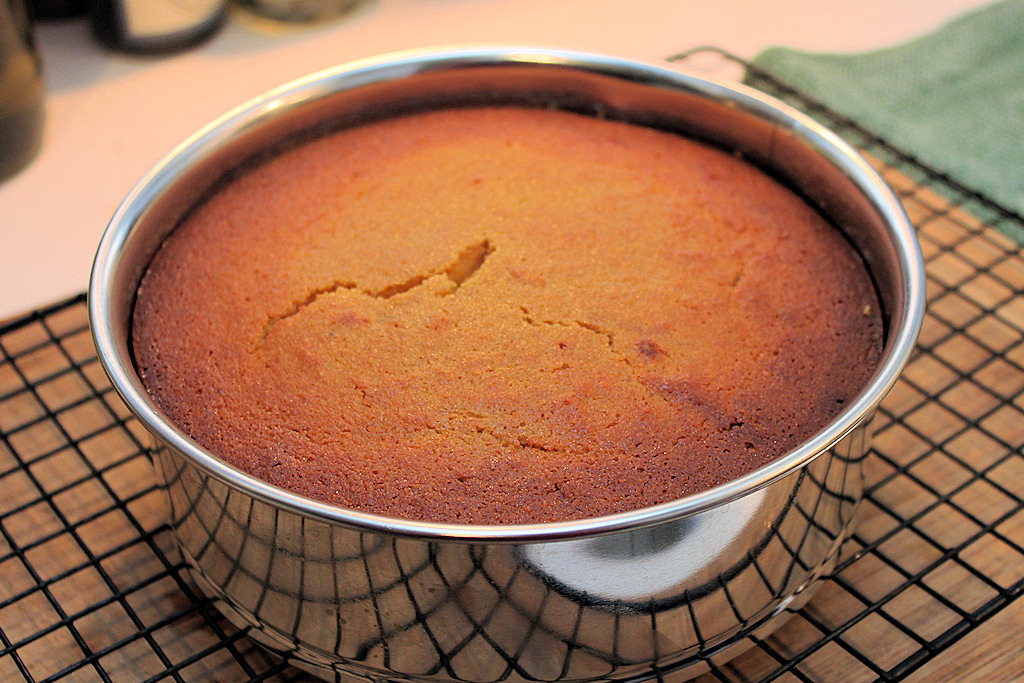
Torte #1 after an hour of baking. Looks fine on the outside, but the interior was mushy, still.

For the first round of Sweet Sunday, I made an orange ginger torte which has a very sexy, seductive aroma and taste. It has a short list of ingredients: oranges, eggs, sugar, almond meal, ginger (both fresh and candied) and baking powder. I ended up making it twice. The first time the end result, once I got through all of the trials and tribulations, tasted good, but I couldn't post it until I addressed the issues and questions I had or at the very least understood why I ran into problems and made it a second time with adjustments, and I will definitely make it again. I'll note this again in the recipe, but I really think this torte tastes better after the first day and on the third day it was even better - just wrap tightly and store in the refrigerator.

#1: How BIG is Small? ...Because Size Does Matter
  • After I made it the first time the first thing I came to learn was that your idea of a small, medium or large orange may differ from mine and this is a perfect example of why weight is a better way to measure, especially in baking. The recipe called for 2 large or 3 small oranges. I had several Moro blood oranges and 3 of them that I considered small. The cake took two hours to fully cook instead of the one called for in the recipe. After the first hour, the insides were like oatmeal. I emailed the author (Clotilde Dusoulier of "Chocolate & Zucchini" fame - a very good blog, full of delicious, interesting recipes and good information) and she was gracious enough to update the recipe with the weight (1 1/3 lbs for the oranges) and also give a really useful description of how the crumb should appear in the post's comments. She has been blogging for years and her site and recipes are very popular - for good reason -  so there are generally many comments per post. Not all bloggers respond to questions, but she does - and did respond to mine even though the original post was from 2004!
#2 The Right Citrus for the Job
  • I did some research and found that most of the similar recipes were called "Clementine Cake"  and generally called for Clementine oranges (a mandarin hybrid).  Also, I think blood oranges aren't my preferred choice for this torte. They often are a bit dear and I think the special taste and aroma qualities of a blood orange is lost in baking - at least in this torte. When you get your hands on a good blood orange, it is a wonder and not just for the beautifully hued flesh and peel. I can find essence of roses and other floral aromas in the flesh and they are wonderfully juicy.
    Torte Version #2: The recipe from which I started called for a topping of pearl sugar combined with lemon juice and zest. I opted for a glaze made with powdered sugar, orange juice and zest, topped with toasted almonds.

    I think this cake tastes better using an orange with less pith. Less pith=larger ratio of flesh and outside skin (zest) to pith. The second time around, I used 1 1/4 lbs of Murcott tangerines. Murcott tangerines are marketed in some areas as "Honey Tangerines" and are sometimes called Murcott Mandarins (see: UCR College of Natural and Agricultural Science's Citrus Variety Collection- I love this reference site). They are delicious to eat with a bright, sweet flavor and a great aroma. I rarely encounter a seed but cut mine in half horizontally to look for any before I pureed them. I think any thin-skinned mandarin or tangerine with great taste and a thin pith would work just fine.
#3 What is it supposed to look like?
  • Ms. Dusoulier's comment, "...one thing I want to note is that this cake remains a very moist one, even when fully baked. The crumb should feel like it's been soaked in syrup" was so helpful because I wasn't sure. I know tortes made with nut meals or flours will not have the same kind of crumb as a cake or quick bread, but I really didn't know what to expect. Her comment made perfect sense to me and I knew, for my second go-round that it was properly finished.
#4 One last thing - I swear it's the last note.
  • The first time I made it I used a coarse-ground almond meal and the second time, I used a fine-ground almond meal - more flour-like. I didn't see an appreciable difference so use what you have or can get your hands on. I used Bob's Red Mill almond meal both times. 
On to the...
RECIPE: ORANGE GINGER TORTE
Makes 1 8" cake
Equipment: 1 8" spring-form pan. I've seen similar recipes where a 9" spring-form pan was used with nearly identical ingredients, but make sure you check the cake at 30 minutes.

Notes: 
  • I did not have any candied ginger and used more fresh ginger than was called for. I grated about 2/3 of the fresh ginger on a microplane and the remainder on the large-hole side of a box grater and really liked the occasional extra ginger-y punch.
  • This cake is very moist and the crumb should appear as if it's soaked in syrup. It keeps beautifully in the refrigerator. Wrap it very tightly in plastic wrap and bring it to room temperature before serving. I think it just gets better on the second and third day.
  • Even after adjusting the amount of orange, the cake still took 80 minutes instead of the 60 specified in the original recipe.
Ingredients
  • 3 small / 1 1/3 lbs oranges (2/3 kg) (Clementines or Murcott tangerines), preferably organic
  • 6 large eggs
  • 1 1/4 cups (8 3/4 oz or 250 grams) sugar
  • 2 1/3 cups (8 3/4 ounces or 250 grams) almond meal (fine or coarse grind)
  • 1 3-4" piece of ginger, approximately 1" in diameter
  • 1 teaspoon baking powder
  • Scant 1/4 teaspoon salt
  • butter to grease the spring-form pan
Preparation
Preheat the oven to 375F / rack in the middle
  • Wash the oranges well and remove the little green stem-end if it is there. Place them in a deep 2-3 quart, saucepan and cover with water + an extra inch. Place the sauce pan on a burner set to medium-high heat. Bring to a boil, reduce the head and simmer for two hours, adding boiling water if necessary to keep the oranges covered. Drain and cool completely. Cut into quarters (over a bowl) and check for seeds. Puree until completely smooth in a food processor and set aside.
  • Using a microplane grater, grate 2 1/4 " of the fresh ginger into a large bowl. Using the large holes on a box grater, grate the remaining ginger. Add the eggs and beat lightly with a fork. Whisk in the orange puree, the sugar, the almond meal and the backing powder until all the ingredients are thoroughly combined.
  • Pour the batter in the greased spring-form pan. Bake for 40 minutes and check. If it is getting too brown, cover the top with a piece of foil. Continue to cook for 1 hour or if necessary, longer. Cook in additions of 10-15 minutes and check after each period. You should be able to stick a toothpick or slim skewer into the cake and just see a few crumbs when it's done. If it gets too brown on top, cover it with foil and continue.
  • When complete, let the cake cool on the rack for 5 minutes. Run a knife (I use a very flat, plastic spatula to avoid scratching the pan), loosen the outer round and remove it. Allow the cake to rest on a rack until completely cooled.
  • To keep, wrap it tightly in plastic wrap and store in the refrigerator. Serve at room temperature.
reade more... Résuméabuiyad

A Simple Soup of Sorrel, Leeks and Potato

Food bloggers photography dilemma: how do you photograph a VERY tasty soup that has the unfortunate hue of an army surplus tent? I think the color was due mostly to the color of my vegetable broth which rendered the soup not-so-green. So, before the beauty shot, why not dot the top with olive oil and float a perfectly formed quenelle of greek yogurt?

...that immediately sank to the bottom of the bowl. Oh, well.

Classically, a quenelle is a combination of fish combined with a white sauce, forced through a sieve, formed into the quenelle shape and poached. Now the use is broader, often just referring to the shape - basically a teardrop, where one of the two sides has a bit of a corner. So, I made this beautiful quenelle of greek yogurt and it sank. I should've swirled it in instead. Okay, I've moved on.
Leeks cooking with butter and a little stock.
This soup is dead easy. Except for the butter, salt and pepper, it takes four ingredients, all of which can be swapped out for others. If you have a small russet potato, a leek (or an onion, or shallots) and vegetable stock (or chicken stock, or even water) plus one other vegetable that is soup-appropriate, you can make this soup, or its cousin. If you're missing the "one other vegetable" and have another potato, you've got soup. Sure, you can tuck basil leaves into the blender with your roasted tomatoes when you purée it, or spike carrots with some harissa, but you can also just celebrate the taste of the ingredients, seasoned with just enough salt and pepper.
Sorrel leaves - pinch off the stem below the leaves.
Sorrel is a perennial used as an herb, cooking or salad green. Last week, Lynn and I used it with other herbs to stuff under the skin of a roasted chicken and it worked marvelously. I couldn't decide whether to use it in a sauce or make a soup - and decided on the latter. When I first tasted it raw, I thought, "Oh, okay another chard-ish, kale-ish cooking green." and then it tasted a little puckery (sour -like I had a mild lemon candy in my mouth - without the lemon taste or sweetness) and things got interesting. I really wanted to know what it tasted like without a lot of other competing flavors so I kept it simple: leek cooked in butter, vegetable stock, a small potato and sorrel, purréed after cooking.

After cooking, the puckery, slightly acidic finish in the taste of the raw sorrel goes away and it has a mild flavor that I don't think I can accurately describe or liken to something else - but it was very good.
The diced potato pieces should be completely tender, but should not break apart when you poke a fork into them.
You can make this without the potato and add previously cooked pasta, beans or other grain at the end. You can forego the purée-ing and keep it a little chunky - just chop up the greens as you would chard so that they are spoon up-able after cooking.

RECIPE: SIMPLE SOUP WITH SORREL, LEEKS AND POTATO

4 generous servings
This may be served hot or at room temperature.

You can purée this in a blender, food processor or use a stick blender. If you use the later, you may not achieve a totally smooth purée if that's your goal. If you substitute onion for the leeks use about 1/2 cup, diced. Leeks are milder than onions. If you use a blender or food processor, cool down your soup for a few minutes, fill the blender or food processor no more than 1/3 full. If you use the blender, crack the top just a tiny bit and hold a folded kitchen towel over the stop. Hot liquids when blended, expand and can become volcanic. If you're using a stick blender, make sure you cool the soup down and it is in a deep pot before you start.

If you are using a commercially prepared stock or broth, be conservative in how you season the leeks - you may even wish to pass on adding any salt until you've added the stock or broth.


Ingredients
  • 1 tablespoon unsalted butter or olive oil
  • 1 or 2 leeks (depending on size) white and light green parts washed, medium dice (about 1 to 1 1/2 cups)
  • 4 cups hot stock (chicken, vegetable) or water
  • 1 small (about 4" long) russet potato peeled, medium dice
  • 4 cups sorrel leaves (or spinach or watercress), washed with the stems below the leaves removed.
  • salt and pepper
  • Garnish with a swirl of yogurt (whole milk), half-and-half or cream, a tablespoon per serving will do the trick and some pepper.
Preparation
  • Heat a large sauce pan or small dutch oven (at least 3 quart capacity) over medium high heat. Add the butter and adjust the heat to medium. When the foam has died down, add the leeks and a pinch of salt. Cook the leeks gently, adjust the heat down so they do not brown, but cook until they are soft. If you want to add a little bit of the stock (as I did), add about 1/3 cup.
  • Add the hot stock to the pan and the diced potato. Bring the mixture to a simmer and cover the pot. Cook for about 10 minutes until the diced potato is completely cooked through and offers no resistance when you poke a piece with a fork.
  • Add the sorrel leaves to the pot and stir gently. Simmer for an additional 5 minutes and remove your pan from the heat. Cool down for a few minutes. Puree in thirds (see blender/hot liquid safety note in the head notes) until it is as smooth as you desire. Rinse out the pan and pour in the puréed soup to warm. Serve with a swirl of yogurt, half-and-half or cream - about a tablespoon per serving.
reade more... Résuméabuiyad

Spicy Chickpeas: a Riff on Chana Masala

I dip in and out of Indian cooking and I can claim no expertise but I love the little I've learned about it. I absolutely love what happens when you combine spices and together they become a whole (taste and aroma) yet maintain an individual presence. While I've found good commercial blends, combining from scratch when you have the time - especially with whole spices - is so much better. The -several- recipes I referenced as a base for this dish were titled "Chana Masala". "Chana" (or chole) are chickpeas (garbanzo beans) and "masala" is a term used in Indian cooking -- there are many regions and types so I feel okay generalizing -- referring to a mixture of spices, often dry roasted, or a spice paste.
Draft 2 - with some cooking notes. More changes were made.
including leaving out the last addition of fried mustard seeds
at the end as I really didn't think it added enough
to go to the trouble.
I've seen references to Chana Masala in the regional cuisines of Punjab, Gujarat and Rajasthani. Most refer to the dish being fairly dry (not goopy or soupy) and being served with a fried bread ("bhatoora"). The dish is easily eaten out of hand with bhatoora. In my take on this it isn't completely dry, but far short of soupy.

Also, poblano chiles. Yeah, I used poblanos and they're definitely not used in Indian cooking. I really liked the idea of the slightly smoky flavor of roasted poblano in this dish and I have several in my refrigerator right now. One of my favorite vendors at the SF Ferry Plaza Farmers Market is Catalán Family Farm and they have some of the most beautiful chiles this time of year, as well as a bounty of heirloom tomatoes and other vegetables.

One thing I didn't have on hand that I saw in all my references was amchoor (or amchur) powder - a powder made from dried, green mangoes. I've had green mango salads in Thai restaurants and there's a slight sour-sweet taste that I'm guessing is enhanced in the dried version. Without amchoor powder, I substituted lime - adding the zest of 2 limes to the dish while it was cooking and the juice (about 3 tablespoons) at the very end of cooking, when the pan was off the heat. I don't know how comparable the flavor is, but I was happy with how the limes worked with the dish. A little sweet, a little sour and a slight hint of acid was a great contrast to the aromatic, smokey, spicy and medium heat of this dish.
When the mustard seeds start popping, be ready with the onions, otherwise the mustard seeds will jump out of the pan.
This dish is great as a side or as an entree. I ate it again tonight as a side with some left over roast chicken from Friday's dinner.


RECIPE: SPICY CHICKPEAS INSPIRED BY CHANA MASALA

Serves 2 as a main or 4 as a side
.
This is a great opportunity to practice mise en place by getting all of the ingredients either measured out or otherwise prepared. It's especially important to have the onions ready because when the mustard seeds start popping, within a few seconds they'll really start popping - right out of the pan and you don't want them to burn. Or end up all over the stove. Or on the floor. They're feisty.

Ingredients
  • Spice Paste
    • 2-4 dried hot red chiles, soaked in hot water to just cover, until soft ( I used 3 chiles d'Arbol, seeds removed)
    • 2 cloves garlic, roughly chopped
    • 1 tablespoon ginger, grated
    • 1 tablespoon fresh grated turmeric or 2 teaspoons dry
    • 1/4 teaspoon ground cinnamon
    • 1 pinch ground cloves
  • Dry Spices
    • 1 teaspoon fennel seeds
    • 1 teaspoon cumin seeds
    • 1 teaspoon coriander seeds
    • 2 teaspoons black mustard seeds 
  • Aromatics
    • 1 medium onion, small dice
    • 4 tablespoons oil (canola is what I used), divided
    • 1 sweet red pepper (bell, gypsy, sweet Italian) , small dice
  • 2 cups cooked chickpeas
  • 1 cup fresh tomato, medium dice (seeds and juice included)
  • 1 tablespoon amchoor powder or the zest of 2 limes
  • 1 large poblano chile, de-seeded and roasted (skin removed), medium dice
  • Water - 1 to 1 1/2 cups
  • Garnish
    • Juice of 2 limes
    • 1/4 cup cilantro, finely minced + a little extra to garnish the plate
  • Salt and fresh ground pepper
Preparation
  • Prepare the spice paste first. Purée the soaked chiles, including the soaking water, garlic, ginger, turmeric, cinnamon and cloves in a small food processor until it is an homogenous paste. Set aside.
  • In a skillet or large saute pan (3 quarts, should not be non-stick) heated on medium high, toast the cumin seeds, coriander seeds and fennel seeds for about a minute, until they become fragrant and the cumin seeds turn a slightly darker color. Take the pan off the heat. Remove the spices to a plate or bowl and cool for a few minutes. Grind in a spice mill or in a mortar using a pestle. Reserve. Return the pan to the heat - medium high - and add the mustard seeds for about 10-20 seconds, until the seeds begin to pop. When that happens, immediately add 3 tablespoons of oil to the pan, immediately followed by the diced onions.
  • Saute the onions until they are translucent, adjusting the heat as necessary and cook until completely soft and a little golden around the edges. Add the diced red pepper cook until it is tender but still has some structure
  • Clear a spot in the middle of the pan. Combine the spice paste with 1 tablespoon of the oil and add to the the pan. Gently fry the paste, adjusting the heat if necessary to keep it from burning, for a few minutes. Incorporate the spice paste into the onion and pepper mixture.
  • Fold in the chickpeas, tomatoes, amchoor powder (or zest of 2 limes) and the poblano chile
  • When nearly all of the liquid has reduced, take the pan off the heat and stir in the lime juice and the minced 1/4 of cilantro. Combine well and serve immediately.
reade more... Résuméabuiyad